Born: c. 1930 - 2011. Karrkurritinytja (Lake MacDonald), Western Desert Region
Language: Pintupi
Community: Kintore (Walungurru), Northern Territory
Dreamings: Kungka Kutjarra (Two Women), Lupulnga, Hair String, Body Paint (Women's Ceremony), Kuningka (Western Quoll)
Makinti Napanangka was born around 1930 in the country around Karrkurritinytja, the great salt lake known to mapmakers as Lake MacDonald, where the Northern Territory gives way to Western Australia. It is old country, a pale sweep of salt and spinifex ringed by low tali sandhills that shift colour as the sun moves across them, and it holds the rockholes and ceremonial sites that Makinti carried with her for the rest of her life. She grew up living the traditional Pintupi way, and her first sight of white people came when she watched men travelling by camel near Lupul. In the early 1940s she walked in to Haasts Bluff with her family, long before Papunya was built. She later lived at Papunya, and settled at Kintore when that community was established.
Her painting life began late and moved quickly. She was one of the senior women who took part in the collaborative Haasts Bluff and Kintore women's painting project, a body of major canvases completed in 1994 and shown at the Tandanya National Aboriginal Cultural Institute in Adelaide. That project marked the point at which Pintupi women stepped forward as independent artists in the Western Desert movement, rather than working as helpers on paintings belonging to their husbands and brothers. In 1996 Makinti began painting for Papunya Tula Artists, alongside her cousin and painting companion Tatali Nangala, and she went on to become the most senior woman painting with the company as well as a shareholder and director of it.
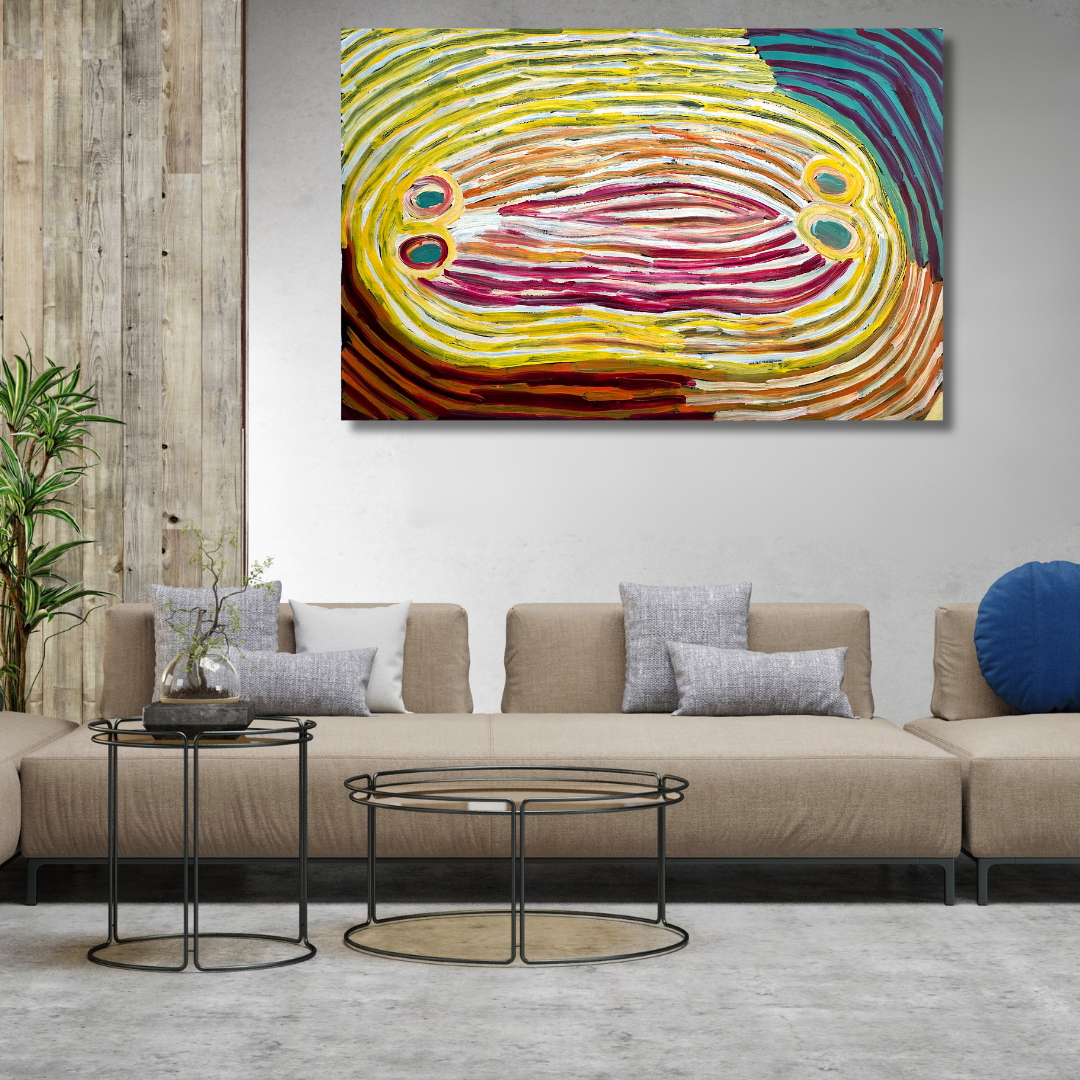
What set her apart was her hand. Where much Western Desert painting is built up through the patient placing of dots with a fine stick, Makinti worked with a loaded brush and a gestural sweep that came straight out of the way ochre is drawn across the body for women's ceremony. Her canvases are layered, thick with paint, alive with movement. Bands of pale line arc and twist across grounds of orange and ochre, lit up with bursts of pink, mauve and yellow. The effect is less a map of country than the feel of country, the rhythm of feet and song and skirts turning in the dust.
Recognition came steadily. Australian Art Collector magazine named her one of Australia's 50 Most Collectable Artists three years running, in 2003, 2004 and 2005, and she was a repeated finalist in the National Aboriginal and Torres Strait Islander Art Award through that decade before taking out the top prize in 2008. By then her work was being acquired by every major public collection in the country, and Utopia Art Sydney's director had described her as the Central Desert's finest painter since Emily Kngwarreye, with no living match for her painterly freedom.
Towards the end of her painting career Makinti's eyesight was failing, but it did not dampen her passion for painting. She would visit our family home, fondly called the farm, and ask for vibrant acrylic paints so she could take them home and later come back with her vivid, colourful canvases.
Makinti passed away on 9 January 2011 at Alice Springs. Later that year she was posthumously appointed a Member of the Order of Australia (AM) in the Queen's Birthday Honours, recognised for her service to the arts as a contemporary Indigenous artist and for her role among the women painters of the Western Desert art movement.
HER DREAMINGS
Kungka Kutjarra (Two Women) — The Two Ancestral Women travelled enormous distances across the desert in the creation time, hundreds of kilometres of it, stopping at rockholes, camping, gathering food and performing ceremony as they went. Their journey is one of the great shared stories of the Western Desert, sung and painted by Pintupi, Warlpiri and Pitjantjatjara people alike. Makinti painted the line of their travels and the ceremonies they left behind.
Lupulnga — A rockhole site south of Kintore, and the place most closely bound to Makinti's name. Water in this country is everything, and a rockhole is not simply a waterhole but a living site of law, ceremony and belonging. Seen from above, as so many desert artists see their country, the site sits within the pale ring of surrounding sandhills like the still centre of the whole landscape. It was an untitled painting of Lupulnga that won her the nation's top Indigenous art prize.
Hair String — Pintupi women spin string from human hair and wear it as skirts and belts during ceremony, the loose strands swinging and lifting as they dance. The looping, flowing bands of colour running through Makinti's work are these skirts in motion. It is a subject she made entirely her own, until the twisting line became her signature.
Body Paint (Women's Ceremony) — The designs painted onto women's bodies for ceremony, distilled down to their essential shapes and let loose across the canvas. Makinti did not so much depict these designs as perform them, using the same broad, confident sweep of the hand that lays ochre onto skin.
Kuningka (Western Quoll) — A small native carnivore of the desert country, now vanished from much of its old range. In Makinti's work it appears in the roundels and circles that sit among the flowing lines.
AWARDS AND RECOGNITION
2011 Member of the Order of Australia (AM), Queen's Birthday Honours, awarded posthumously
2010 Alice Prize, Alice Springs — Finalist
2009 26th National Aboriginal and Torres Strait Islander Art Award, Darwin — Finalist
2008 25th National Aboriginal and Torres Strait Islander Art Award, Darwin — Winner, for an untitled painting of Lupulnga
2004 Wynne Prize, Art Gallery of New South Wales — Finalist
2003, 2004 and 2005 Named one of Australia's 50 Most Collectable Artists, Australian Art Collector magazine, three consecutive years
2003 Clemenger Contemporary Art Award, National Gallery of Victoria — Finalist
2003 20th National Aboriginal and Torres Strait Islander Art Award, Darwin — Finalist
1997, 1998, 2001, 2002 National Aboriginal and Torres Strait Islander Art Award, Darwin — Finalist
SELECTED EXHIBITIONS
1995 Minyma Tjukurrpa: Kintore and Haasts Bluff Canvas Project, Tandanya National Aboriginal Cultural Institute, Adelaide
2000 Papunya Tula: Genesis and Genius, Art Gallery of New South Wales, Sydney
2003 Emerge, Museum and Art Gallery of the Northern Territory, Darwin
2003 Clemenger Contemporary Art Award, National Gallery of Victoria, Melbourne
2005 to 2006 Luminous: Contemporary Art from the Australian Desert, touring regional galleries in New South Wales, Victoria and South Australia
2012 18th Biennale of Sydney, All Our Relations
2012 Ancestral Modern: Australian Aboriginal Art from the Kaplan and Levi Collection, Seattle Art Museum, USA
2013 Crossing Cultures: The Owen and Wagner Collection of Contemporary Aboriginal Australian Art, Toledo Museum of Art, USA
2015 Tarnanthi: Festival of Contemporary Aboriginal and Torres Strait Islander Art, Art Gallery of South Australia, Adelaide
2016 Artist's Hand, Collectors' Eye: The Angel Gift, National Gallery of Victoria, Melbourne
2019 Borrowed Scenery, Campbelltown Arts Centre, Sydney
2021 Papunya Tula: 50 Years, S.H. Ervin Gallery, Sydney
2022 Irrititja Kuwarri Tjungu: Past and Present Together, Kluge-Ruhe Aboriginal Art Collection, University of Virginia, USA
COLLECTIONS
National Gallery of Australia, Canberra
Art Gallery of New South Wales, Sydney
National Gallery of Victoria, Melbourne
Queensland Art Gallery and Gallery of Modern Art, Brisbane
Museum and Art Gallery of the Northern Territory, Darwin
University of Melbourne Art Collection
Seattle Art Museum, USA
Hood Museum of Art, Dartmouth College, USA
Kluge-Ruhe Aboriginal Art Collection, University of Virginia, USA
This painting was purchased directly from Makinti, and a gallery certificate of authenticity will be provided with the sale.