Born: c.1938-2013, Watulka, Gibson Desert, Western Australia
Language: Pintupi
Dreamings: Women's Ceremony and Wirrulnga
Ningura Napurrula was born around 1938 at Watulka, in the East Gibson Desert south of Kiwirrkurra. It is old, spacious country of red sandhills, spinifex plains and rockholes that hold water long after the rain has gone, and she spent her early life moving through it on foot, living the way Pintupi families had lived there for thousands of years. Her first journey out of the desert came in 1962, travelling with a Northern Territory Welfare Branch patrol so her young son could be treated at Papunya. She returned to Kiwirrkurra that same year, and came back again the following year with her family group during the drought migration that brought many Pintupi people east. The family later settled at Walungurru, known as Kintore.
She was married to Yala Yala Gibbs Tjungurrayi, a founding painter of Papunya Tula and one of the great exponents of the men's Tingari style. Through the 1980s at Kintore, Ningura worked on his canvases, laying in the dense background dotting that carried his designs. In 1995 she joined the Kintore and Haasts Bluff women's painting project, then in its second year, and it was there that her own hand emerged. She formally joined Papunya Tula Artists in 1996 as part of the group of senior Kintore and Kiwirrkurra women whose arrival reshaped the company and, with it, the direction of Western Desert painting. Her first solo exhibition came in 2000 at William Mora Galleries in Melbourne, the same year her work appeared in Papunya Tula: Genesis and Genius at the Art Gallery of New South Wales. After her husband's death in 1998 her output grew, and so did her standing.
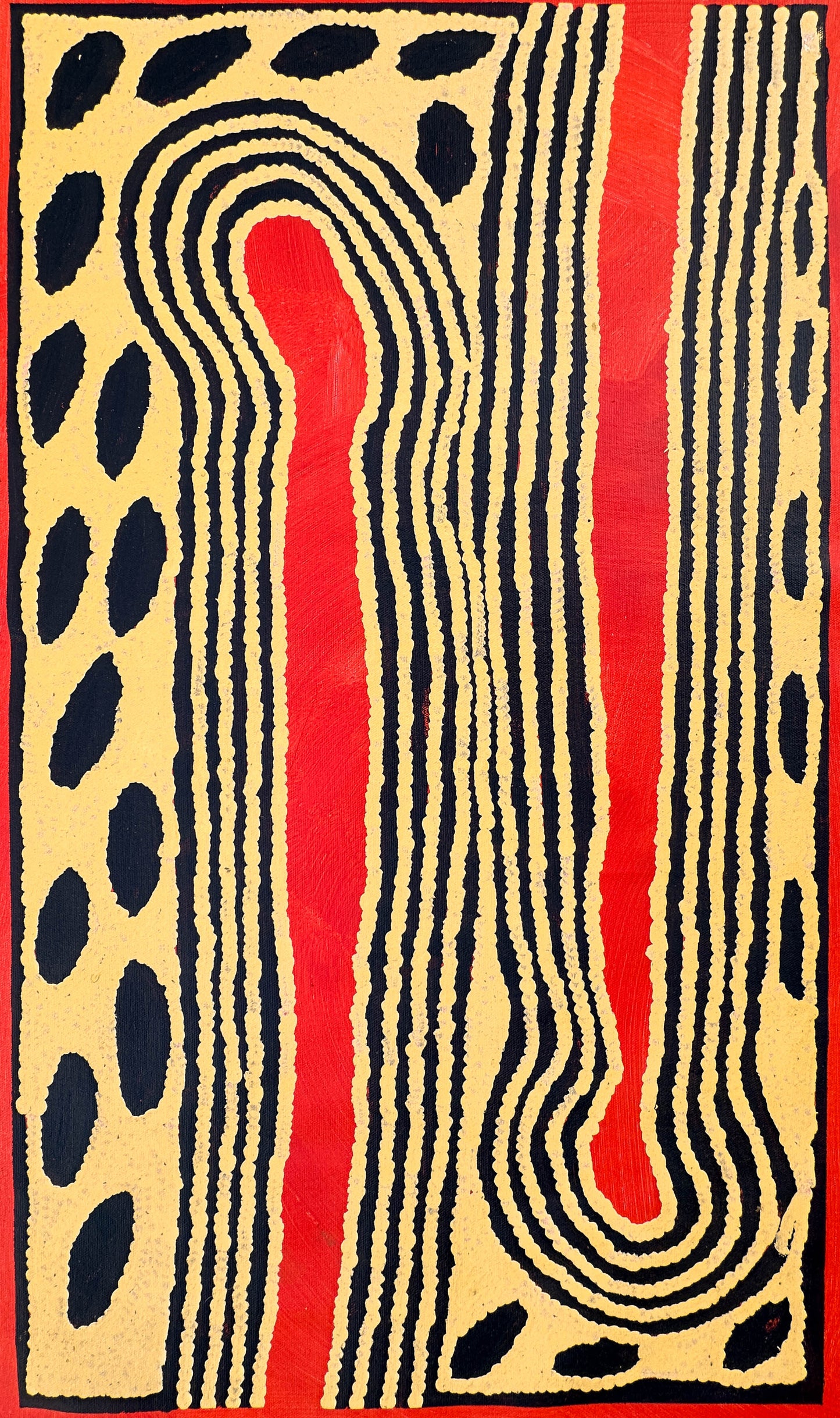
Her work is unmistakable. She built her canvases from heavy layers of acrylic, laid on with real physical weight, and organised them around strong sweeping linear designs. Long curved bands, concentric roundels and dense rows of dotting move across the surface with a rhythm that feels almost like breathing. Her palette shifts from soft pinks and corals to hot yellows, deep reds, ochres and stark black and white, and she used colour boldly, letting the ground push up through the layers above it so the surface reads with real depth. That layering has been compared to the way women apply paint to skin in ceremony. Where her husband painted men's Tingari, Ningura painted the lives, journeys and ceremonial law of women, and she is remembered as much for her authority as a keeper of that knowledge as for the paintings themselves. She also gave works to help establish and support the Western Desert dialysis service, and one of her designs travelled across remote communities on the side of its truck.
DREAMINGS
Women's Ceremony - This is Awelye, the ceremonial life of Pintupi women. Ningura painted the gatherings of ancestral women who moved across her country in the Creation era, the ceremonies they performed at the sites they stopped at, and the objects made and used in that law, including the hair string skirts and the digging sticks carried on the journey. The long curved bands and arcs that dominate her canvases carry these forms. It is women's business, held and passed down by senior women, and Ningura held it at the highest level.
Wirrulnga - A rockhole site east of Kiwirrkurra, and the place she returned to more than any other. Wirrulnga is a women's site associated with birth and with the beginning of life, and much of her later work centres on it. Seen from above, the way so many desert artists work, the concentric roundels mark the rockhole itself and the surrounding arcs the rocky rises around it. Her large design for the ceiling of the Musée du quai Branly in Paris was drawn from a Wirrulnga painting.
EXHIBITIONS AND COLLECTIONS
Ningura exhibited widely in Australia and internationally from the late 1990s onward, and her work entered every major Australian state and national collection as well as significant museums in Europe and the United States.
SELECTED EXHIBITIONS
2006 Musée du quai Branly, Paris, France
2005 Palais de Tokyo, Paris, France
2005 Deste Foundation Centre for Contemporary Art, Athens, Greece
2004 Mythology and Reality, Heide Museum of Modern Art, Melbourne
2004 Peintres Pintupi, Galerie DAD, Mantes-la-Jolie, France
2003 Australian Contemporary Aboriginal Art, Prague, Czech Republic
2003 Masterpieces from the Western Desert, London, United Kingdom
2002 Araluen Arts Centre, Alice Springs
2001 18th Telstra National Aboriginal and Torres Strait Islander Art Award, Darwin
2001 Aborigena, Palazzo Bricherasio, Turin, Italy
2000 Papunya Tula: Genesis and Genius, Art Gallery of New South Wales, Sydney
2000 William Mora Galleries, Melbourne (first solo exhibition)
AWARDS AND COMMISSIONS
2006 Commissioned for the Australian Indigenous Art Commission, Musée du quai Branly, Paris. One of eight artists chosen, and the only woman from the Western Desert. Her design is painted permanently into a first floor ceiling of the museum
2007 and 2008 Named among Australia's 50 Most Collectable Artists by Australian Art Collector
2002 Her painting reproduced on an Australia Post stamp
2002 Highly Commended, Alice Prize
2001 Finalist, 18th Telstra National Aboriginal and Torres Strait Islander Art Award
COLLECTIONS
National Gallery of Australia, Canberra
Art Gallery of New South Wales, Sydney
National Gallery of Victoria, Melbourne
Queensland Art Gallery, Brisbane
Art Gallery of South Australia, Adelaide
Museum and Art Gallery of the Northern Territory, Darwin
National Museum of Australia, Canberra
Australian Institute of Aboriginal and Torres Strait Islander Studies, Canberra
Artbank, Sydney
Musée du quai Branly, Paris, France
Musée des Confluences, Lyon, France
Hood Museum of Art, Dartmouth College, United States
National Museum of Women in the Arts, Washington, United States
Ningura passed away in 2013. Her sons Morris Gibson Tjapaltjarri and Adam Gibbs Tjapaltjarri, and her daughter Glenys Napaltjarri, all paint, and the family's connection to this country continues through their work.
We do not publish photographs of artists who have passed away. Ningura's name appears here so that the painting can be correctly identified and attributed, and for no other reason. Out of respect for the old ways.
This painting can be hung vertically or horizontally.
This painting was purchased directly from Ningura. A gallery Certificate of Authenticity will be provided with the sale.